Features
Everything a website needs.
In one plugin.
Most WordPress sites are a builder plus fifteen plugins that have never met. ambera ships the whole set — designed together, updated together, in one interface.
The theme,
not just the page.
Header, footer, single post, page, archive, search, list item and 404, each with a rule that says where it applies, plus menu templates — nine kinds in all. Change one, and every page that uses it changes with it.


Rebuild a page
that is live.
In WordPress every change to a published page goes live the moment you save it. Here two states sit side by side: the published one visitors see, and the draft you work on. Saving changes nothing out there — the toolbar says «Draft — not live». You publish when it suits, now or at a time you set. And two versions can be put next to each other, with what changed marked in green, red and orange.
Sell access,
teach a course.
Memberships with a price and a term — monthly, yearly, once or for good. Whole pages, a category, a block or a file for members only; renewals run by themselves and reminders go out in time. Courses come with it: lessons with a video and a file, a pace you set, a quiz at the end and points for finishing. Members sign in on your site and stay there.


Dates many people
come to.
Not the same as appointments: there one person takes a time, here twenty take the same date. Places, a price, a location, and a sign-up done in one step without an account. The last place is handed out under a lock, and whoever is late lands on a waiting list that moves up by itself when somebody cancels.
Adverts Google
can find.
A job belongs on your own site — and from there into the jobs box on Google, because that is where people look. So the fields are the ones Google Jobs asks for, and the screen says which one is still missing. Categories, the workload as a figure, and the application with its papers right next to it.


One address,
whatever you upload.
Price list, brochure, form — in groups, each with a line saying what it is, delivered under an address of the plugin instead of a link into the uploads folder. Replace the file and every page, newsletter and bookmark still leads to the current one. Counted per day, and for members only if you say so.
Asked once.
Read before it shows.
A few days after an order that went out or an appointment that was kept, the site asks — once, with a link that needs no account. Five stars and two lines. What comes back waits until you have read it; let it through and the block shows it by itself, with the average above.


Ask the site.
It answers.
A window in the corner, or a box on a page. It answers from the questions and answers you entered, from the pages of the site — and with an AI key in full sentences, in the language of the question. What it cannot answer waits in the client area with a field for the answer; next time it says it itself. No outside script, no chat service, no cookie.
A template in.
A page of blocks out.
Upload a .html file or a zip with its pictures, and it stands as a page of blocks — every style of the template a setting on its block, its fonts and colours those of the site, header, footer and menu as templates. What it could only do with a script is listed, with the block that takes its place.


No enquiry
slips through.
Tick “This form creates leads” in the form builder, and from then on each enquiry is a card in New. A second message from the same address joins the card already open. What is overdue or due today heads the board, followed by the people who have waited longest; the follow-up itself turns up under Due now like every other task.
Set the hours once.
Every page follows.
A schedule holds the week, the exceptions and the public holidays — Easter and everything hanging off it worked out on the site itself. The Opening hours and Next date blocks read from it, so footer, contact page and template change together, and open now is worked out in the visitor's browser.


How fast, how found.
Every day.
PageSpeed on a phone and a desktop, the place on Google Maps for each keyword in your town, the SEO check of every page — run daily on your own Google key and boiled down to five 0–100 scores. Under every cross stands the step that clears it.
Your agency.
Not ours.
With Agency Unlimited the login page, the client area, the editor and the bar above the site carry your name, logo and colour. Help leaves out our version and our videos, and the support button goes to you. Administrators still see everything.

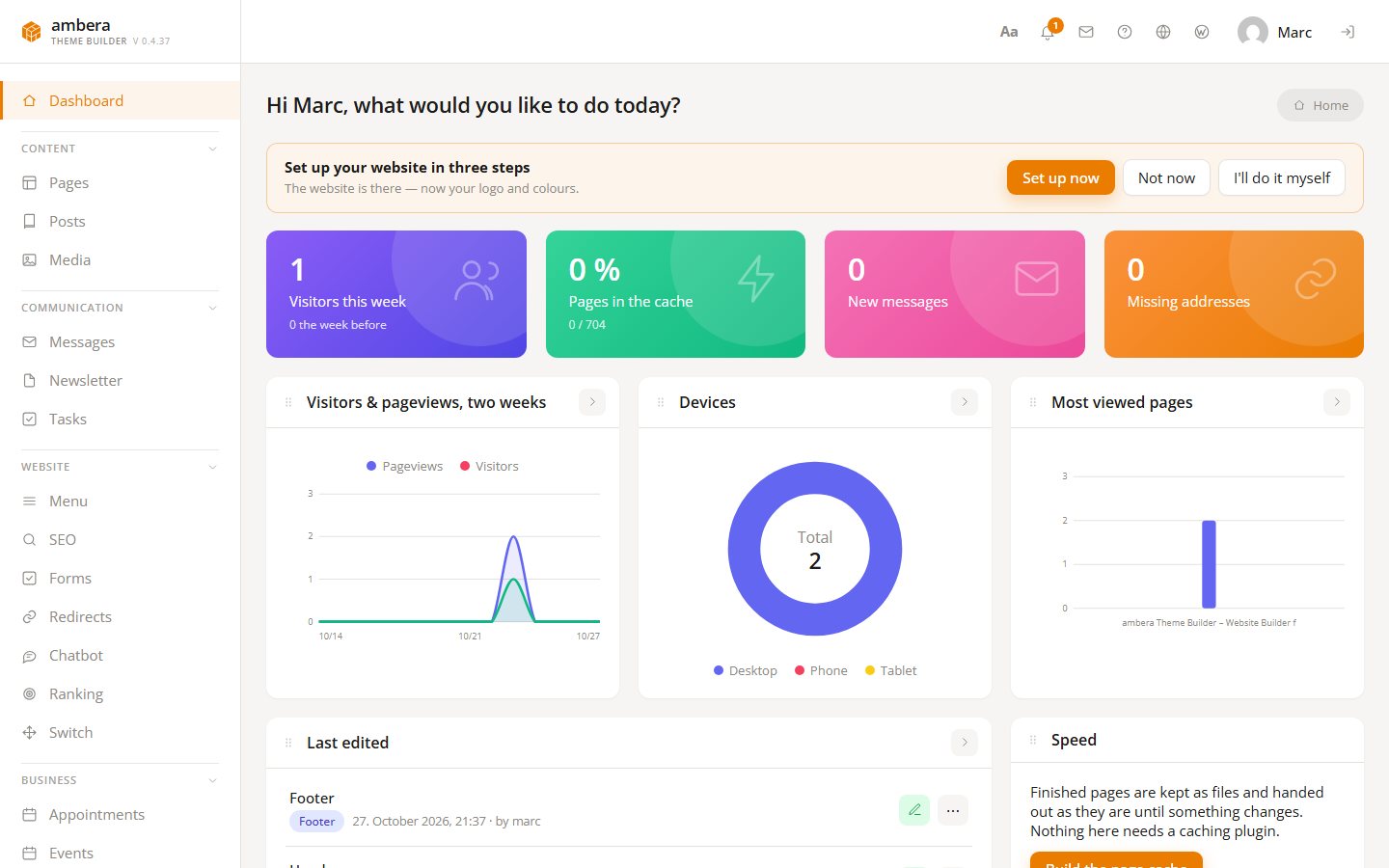
Three steps.
Then a website.
A fresh site shows a card on the dashboard: pick your trade and a finished website, give it your logo and three colours, done. The logo goes into the header in place of the site name, the colours into the palette, the rest follows the demo. Not now keeps the card quiet for a week; everything can be changed later, page by page.
Leave Elementor.
Keep the pages.
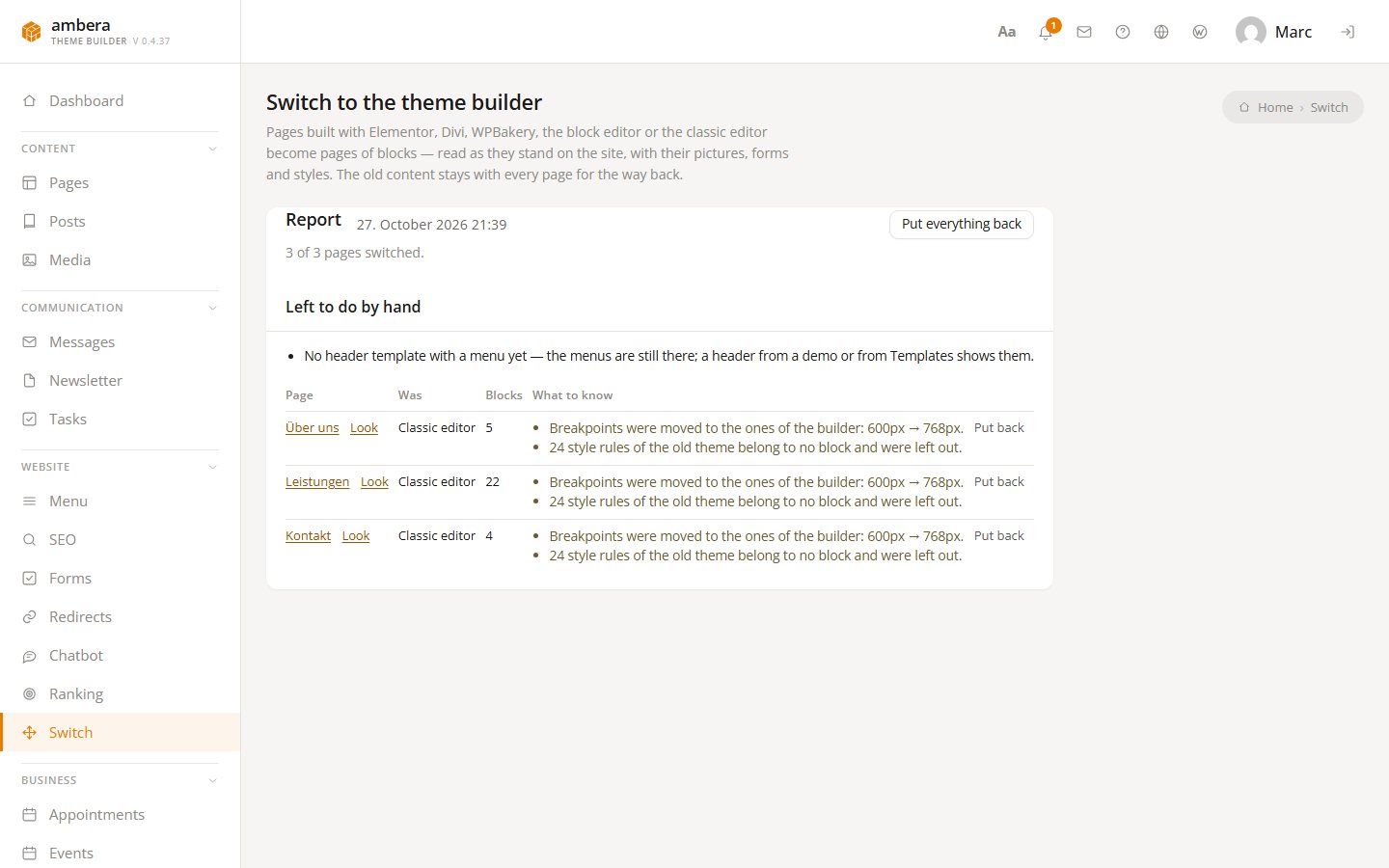
The Switch screen lists every page still built with Elementor, Divi, WPBakery, Beaver Builder or the WordPress editors and rebuilds each one from blocks — read as it stands on the site, with pictures, forms and styles, one after the other while the site keeps running. A report per page, and Put back for the way back. Coming from Wix, Jimdo, Squarespace or any other host? Paste the address, and up to forty of its pages arrive as drafts.
The WordPress theme builder has a name.

Built in Switzerland. Built for WordPress.